How Difficult Is the Inca Trail? Altitude, Fitness and Training
By our guides in Cusco · Updated 31 October 2026 · 11 min read
Day by day: where it gets hard
| Day | What you walk | How it feels |
|---|---|---|
| Day 1 | KM 82 → Wayllabamba, ≈ 12 km | Gentle warm-up along the river, a few short climbs |
| Day 2 | Up to Dead Woman's Pass (4,215 m) and down to camp | The hard day: 5–7 hours, ≈ 1,200 m of climbing, then steep stairs down |
| Day 3 | Two more passes, ruins and cloud forest, ≈ 16 km | Long but beautiful; lots of stone steps |
| Day 4 | Wiñay Wayna → Sun Gate → Machu Picchu | Early start, short and easy — mostly emotional |
Altitude: the real challenge
Cusco sits at about 3,400 m and the trail's high point is 4,215 m. Distance is not what makes people slow down — thin air is. Almost everyone feels breathless on the climbs; mild headaches on the first days in Cusco are common.
- Arrive in Cusco at least 2 days before your trek (3 is better).
- Walk slowly, drink lots of water and coca tea, and go easy on alcohol the first nights.
- Talk to your doctor about altitude medication before you travel.
- Our guides carry first aid and emergency oxygen and are trained to spot altitude sickness.
How fit do you need to be?
If you can walk 5–6 hours on hilly ground with breaks, you can do the Inca Trail. You don't need to be an athlete. Our groups regularly include hikers in their 50s and 60s. Your guide sets a steady pace and nobody is left behind.
A simple 6–8 week training plan
- 2–3 times a week: 45–60 minutes of brisk uphill walking, stair climbing or a stair machine.
- Once a week: a long hike of 4–6 hours with a light day pack, ideally with hills.
- Strengthen your legs (squats, lunges, step-ups) — the descents are hard on knees.
- Break in your hiking boots before the trip. Trekking poles help a lot on the stairs.
Easier ways to reach the Sun Gate
If 4 days feels like too much, the Short Inca Trail is about 12 km in one day with a high point of 2,720 m — rated 2 out of 5 on our scale — and still ends at the Sun Gate with a night in a hotel.
How hard is the Inca Trail compared with other treks?
| Trek | High point | Our difficulty (1–5) | Typical walking day |
|---|---|---|---|
| Short Inca Trail (2 days) | 2,720 m | 2 · Easy to moderate | ≈ 12 km, 6–7 hours |
| Lares Trek (4 days) | ≈ 4,450 m | 3 · Moderate | 4–6 hours |
| Classic Inca Trail (4 days) | 4,215 m | 4 · Challenging | 5–8 hours |
| Salkantay Trek (5 days) | ≈ 4,600 m | 4 · Challenging | 6–8 hours |
Compared with famous hikes elsewhere, the Inca Trail is harder than most day hikes in national parks because of the altitude and the stone steps, but much easier than a high-altitude summit trek such as Kilimanjaro or Everest Base Camp. There is nothing technical: you never need ropes or climbing skills.
The stairs: what nobody tells you
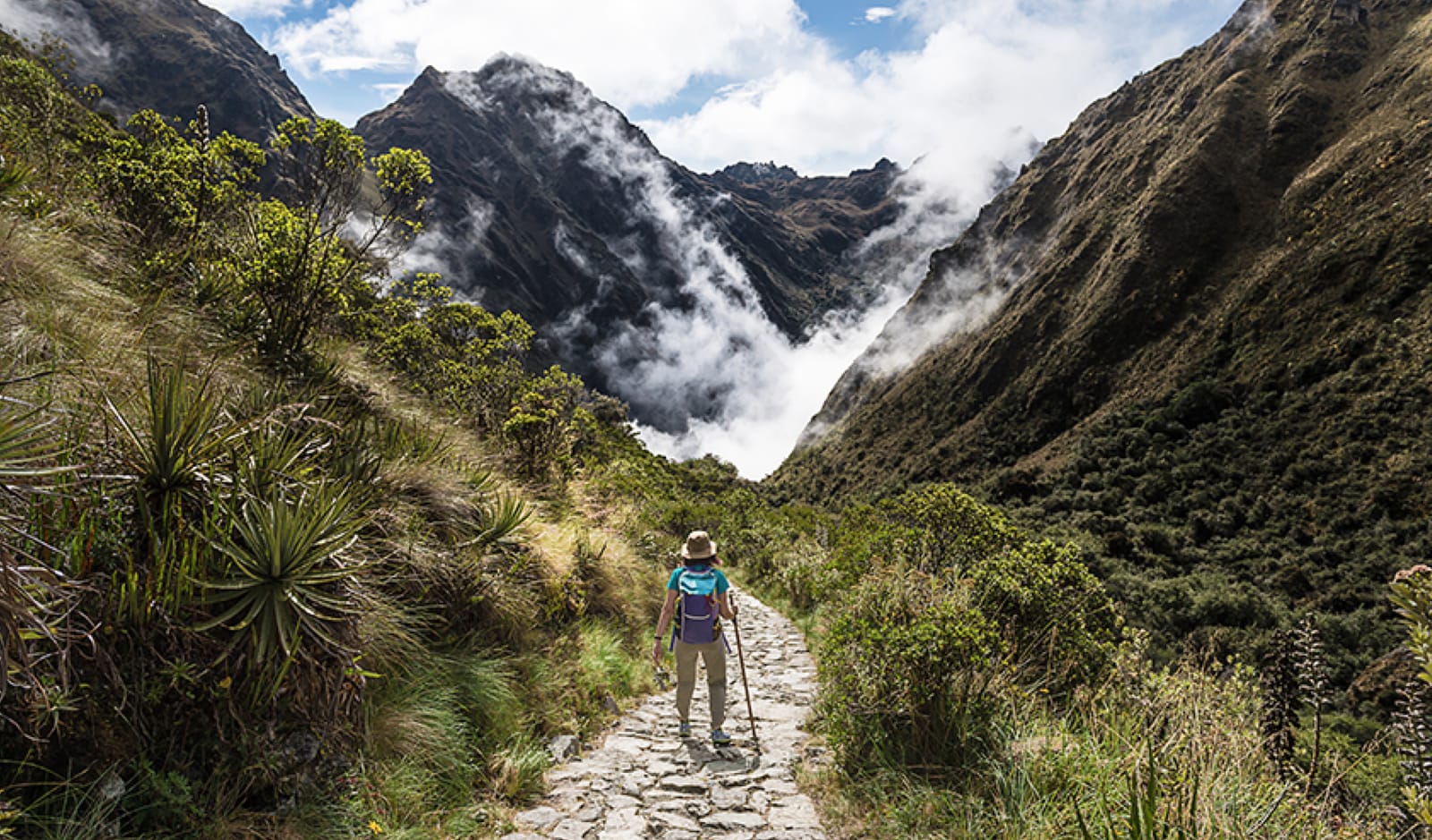
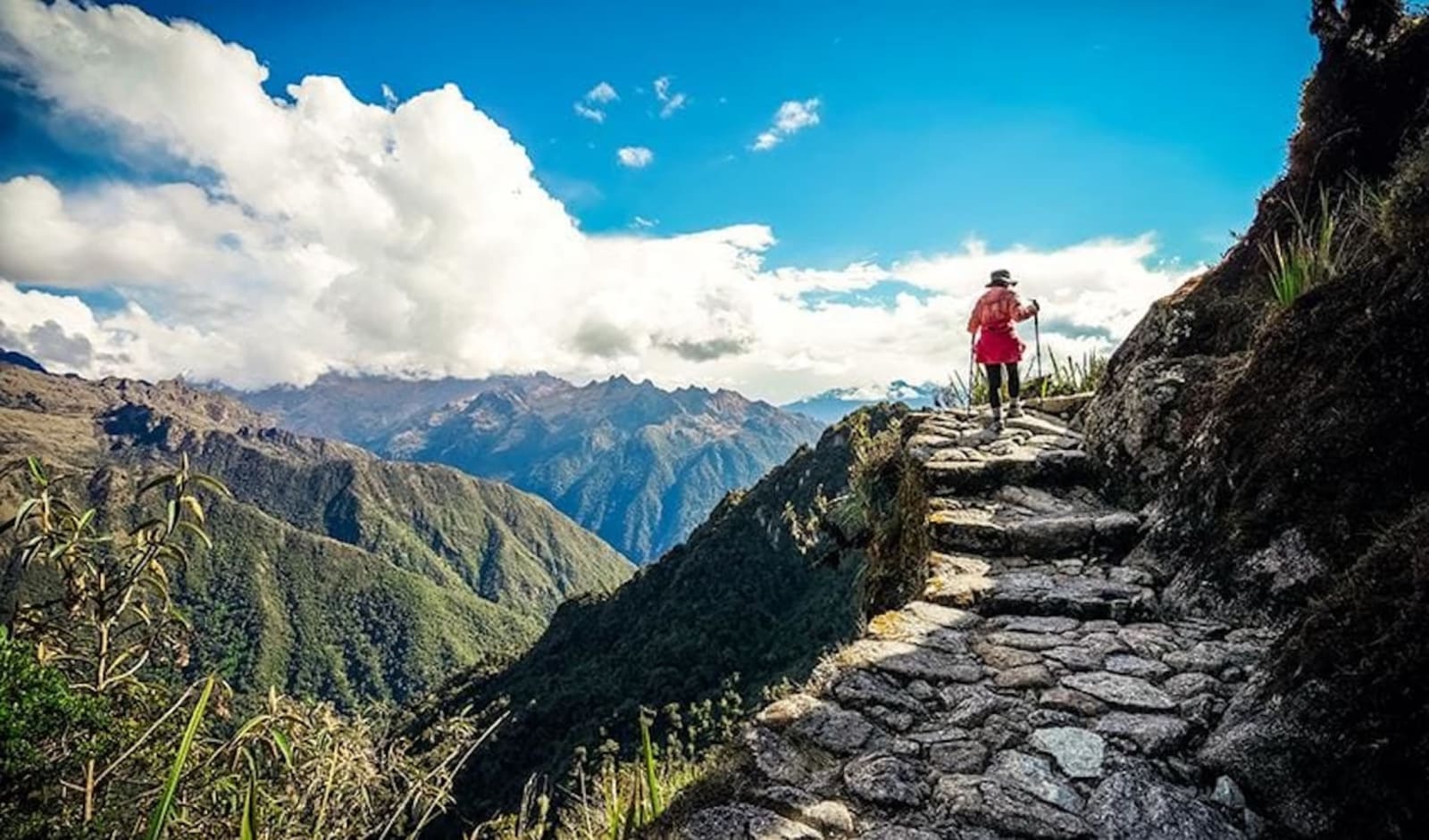
The Inca Trail is a stone road, and much of it is stairs. Some steps are knee-high, uneven and wet in the rainy season. Going up makes you breathe hard; going down is what tires your legs. Day 2 ends with about two hours of steep descent, and Day 3 has thousands of steps through the cloud forest. Trekking poles take a lot of strain off your knees, and you can rent a pair from us when you book.
Walk at your own rhythm, take short steps and keep your weight over your feet. Our guides teach a simple technique on the first day, and we make regular stops so nobody feels rushed.
Weather and how it changes the difficulty
From May to September the trail is dry, with sunny days and cold nights that can drop below zero at the higher camps. From November to March it rains more, which makes the stone slippery and the days feel longer. Good boots with grip, a rain jacket and layers make a huge difference. The trail is closed in February.
Altitude sickness: signs and what to do
- Common, mild signs: headache, shortness of breath, poor sleep, low appetite.
- Warning signs: strong headache that doesn't go away, vomiting, confusion, loss of balance.
- What helps: slowing down, drinking water, resting, and going down if symptoms get worse.
- Our guides check on every hiker during the trek and carry oxygen and first aid.
Most hikers feel the altitude for a day or two in Cusco and then adapt. That's why spending 2 or 3 days in Cusco or the Sacred Valley before the trek is the single best thing you can do to make the Inca Trail easier.
What makes it easier: our fully supported style
You walk, we take care of everything. Porters carry the tents, the kitchen and the food, so you only carry a day pack with water, a jacket, sunscreen and your camera. When you arrive at camp, your tent is already up and hot drinks are ready. Our trail chef cooks three-course meals that give you the energy for the next day. That support is what turns a hard trek into an enjoyable one.
Who should think twice
If you have heart or lung problems, serious knee problems, or you are pregnant, talk to your doctor before booking. If 4 days of walking feels like too much, choose the Short Inca Trail, which ends at the same Sun Gate. For anyone else who walks regularly and comes prepared, the Inca Trail is a challenge you will be proud of.
What to pack to make the trek easier
- Broken-in hiking boots with good grip.
- Trekking poles (or rent them from us).
- Warm layers, a down jacket and a hat for cold nights.
- A rain jacket and pack cover.
- Sunscreen, sunglasses and a sun hat.
- A 1–2 litre water bottle and water purification tablets.
- Snacks you love for the climb to Dead Woman's Pass.
Your first two days in Cusco: how to prepare
The days before the trek matter as much as your training at home. When you land in Cusco, take it easy: walk slowly around the old town, eat light meals and drink plenty of water. Many hikers sleep better and adapt faster in the Sacred Valley, which is about 600 m lower than Cusco, so it is a great place to spend your first night or two.
On the second day, try a short walk with a few hills, such as up to San Cristóbal or Sacsayhuamán, to test how your body feels. The evening before the trek, your guide holds a briefing where you meet the group, receive your duffel bag for the porters and ask any last questions. Pack your day bag the night before and go to bed early: pick-up for the Classic Inca Trail is usually before 5 am.
If you feel unwell before the start, tell us. Our team in Cusco can recommend a clinic and, when possible, help you plan around it. Arriving rested and acclimatized is the easiest way to make the Inca Trail feel less hard and much more enjoyable.
Questions hikers ask us
Is the Inca Trail harder than Kilimanjaro?
No. Kilimanjaro goes much higher (5,895 m). The Inca Trail's high point is 4,215 m and the days are shorter.
What is the hardest part of the Inca Trail?
Day 2: the climb to Dead Woman's Pass at 4,215 m, followed by a steep stone staircase down to camp.
Do I have to carry my own backpack?
Only a day pack with water, a jacket and your camera. Our porters carry the tents, the food and 5–7 kg of your personal things.
What if I can't continue?
Your guide decides with you. In most places there is a way back down, and our team in Cusco organises the return.
Can a beginner hike the Inca Trail?
Yes, if you are in reasonable health, prepare for 6–8 weeks and arrive in Cusco 2 days early. Many of our hikers have never done a multi-day trek before.
How many hours a day do you walk on the Inca Trail?
Between 5 and 8 hours on most days, with breaks. Day 4 is short: about 2 hours to the Sun Gate.
Is the Inca Trail dangerous?
No. The path is well built and our guides are trained in first aid. The main risks are altitude and slipping on wet steps, which we manage with pace and good advice.
What is the age limit for the Inca Trail?
There is no official upper age limit. Our groups regularly include hikers in their 60s. Children can go with their parents.